
Learning Hub
How to Choose the Best Teether for Your Baby
“My baby refuses every teether I buy.”
“Do I really need a teether, or is it just another baby product?”
“Why does my baby only want to chew my fingers instead?”
If you've found yourself asking these questions, you're certainly not alone.
Choosing a teether can feel surprisingly overwhelming. A quick search reveals hundreds of options in different shapes, materials and colours, all claiming to be the best.
The reality is that the best teether isn't about trendy designs or clever marketing. It's about finding one that's safe, easy for your baby to hold and suited to their changing teething needs.
Understanding why babies chew and what they may need at different stages makes choosing the right teether much simpler.
New to teething?
Start with our complete guide to understand what happens from birth through to toddlerhood.
Why Do Babies Need a Teether?
Many parents assume babies chew simply because their gums are sore.
While discomfort can be part of the story, there's much more happening.
Long before teeth become visible, babies naturally explore objects using their mouths and may seek pressure against their gums.
Chewing can give babies an appropriate way to:
- explore different textures
- develop oral awareness
- practise coordinated mouth movements
- respond to pressure or discomfort around their gums
- satisfy a normal developmental instinct
This is why babies often chew on their hands, toys, muslin wraps or your fingers months before their first tooth appears.
To understand why this behaviour can begin before active teething, read Why Do Babies Chew Everything?
Chewing isn't a bad habit.
It's a normal part of early exploration and development.
Oral development insight
Babies experience much of the world through their mouths before they can crawl or walk.
Providing suitable, age-appropriate objects to chew gives them an alternative to unsuitable household items.
When Should You Introduce a Teether?
Many babies may benefit from a teether before their first tooth appears.
Early signs that your baby may be looking for something appropriate to chew include:
- chewing on their hands
- biting your fingers
- frequently mouthing toys
- increased drooling
- rubbing their gums
- chewing clothing or bibs
For many babies, these behaviours begin between approximately 3 and 6 months, although every child develops differently.
You don't necessarily need to wait until you can see a tooth.
Not All Teethers Are Created Equal
A teether spends a lot of time in your baby's mouth.
That means it needs to do far more than simply look cute.
When comparing teethers, consider whether the product is:
- easy for little hands to hold
- able to reach different areas of the gums comfortably
- made with different chewing textures
- durable enough for regular use
- easy to clean and inspect
- designed specifically for babies
Always follow the manufacturer's age recommendations, use and cleaning instructions.
Five Features That Make a Great Baby Teether
1. Easy to grip
One reason babies may reject a teether is that they struggle to hold or position it.
Look for:
- lightweight construction
- multiple grip points
- ergonomic handles
- a shape babies can turn and reposition
The easier it is to hold, the easier it may be for your baby to use the teether independently under supervision.
2. Multiple textures
As different teeth move through the gums, babies may seek different kinds of pressure.
Some may prefer gentle bumps, while others may push against firmer ridges.
A teether with multiple textured surfaces gives babies several areas to explore.
3. Food-grade silicone
Food-grade silicone can be a practical material for baby teethers because it is:
- flexible
- durable
- gentle against delicate gums
- easy to clean
Choose products designed specifically for infant teething and follow all supplied safety and care instructions.
4. One-piece construction
A one-piece design can be easier to clean and inspect because there are fewer joins or spaces where moisture and dirt can collect.
5. Easy to clean
Realistically, your baby's favourite teether may spend almost as much time on the floor as it does in their mouth.
Choosing one that's quick and simple to clean can make everyday use much easier.
Silicone, Wooden or Water-Filled: Which Is Best?
There isn't one perfect material for every family.
Each option has different features and care requirements.
| Material | Advantages | Considerations |
|---|---|---|
| Food-grade silicone | Soft, flexible, textured and generally easy to clean | A practical all-round option when designed specifically for infant teething |
| Wood | Firm, natural feel | May offer fewer textures and can require different cleaning and care |
| Water-filled cooling teethers | May provide a cooling sensation when used according to instructions | Can be heavier and may provide fewer chewing surfaces |
Many parents choose food-grade silicone because it can combine flexibility, durability and straightforward cleaning in one product.
Choosing the Right Teether for Your Baby
Instead of asking:
“What's the best teether?”
Ask:
“What's the best teether for my baby right now?”
| If Your Baby... | Look For... |
|---|---|
| Is just starting to chew | A lightweight, easy-to-grip design |
| Loves chewing fingers | Multiple textured surfaces |
| Has front teeth coming through | Slim chewing areas that can comfortably reach the front gums |
| Is getting back teeth | A design intended to reach further areas of the mouth safely |
| Drops everything | Large handles that are easy to pick up and hold |
| Chews frequently | Durable material designed for regular infant use |
Your baby's preferences may change as different teeth emerge, and that's completely normal.
Learn how these preferences can change as different teeth appear in our month-by-month guide to baby teething stages.
Five Common Mistakes Parents Make When Buying a Teether
Buying the cutest one instead of the easiest one to hold
Babies care much more about comfort and usability than appearance.
Waiting until the first tooth appears
Many babies begin seeking suitable chewing surfaces before a tooth becomes visible.
Assuming all babies like the same textures
Some babies may prefer gentle bumps, while others may prefer firmer ridges.
There isn't one correct texture for every baby.
Freezing every teether
A cooled teether may feel soothing, but a frozen teether may be uncomfortably cold against tender gums.
Only freeze a teether if the manufacturer specifically confirms that it is suitable for freezing.
Forgetting to inspect it regularly
Check teethers regularly for signs of wear, cracking, splitting or other damage.
Stop using and replace a teether if it becomes damaged.
Do You Need More Than One Teether?
Many parents find having more than one teether makes everyday life easier.
For example:
- one in the nappy bag
- one at home
- one at a grandparent's house
- one cooling in the refrigerator, if permitted by the manufacturer's instructions
When teething discomfort appears suddenly, having a clean teether nearby can be useful.
Oral development insight
As new teeth emerge, babies may change how and where they chew.
You might notice them:
- chewing more on one side
- preferring firmer pressure
- rejecting a teether they previously enjoyed
- trying to chew further back in their mouth
Their preferences may change as their mouth and teeth develop.
Why Many Parents Choose Matchstick Monkey
Matchstick Monkey teethers are designed around how babies naturally hold, explore and chew.
The range combines practical features including:
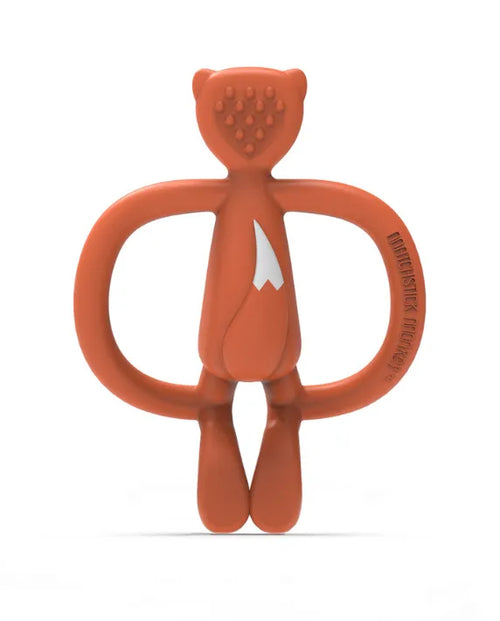
- ergonomic handles designed for little hands
- multiple textures for different chewing preferences
- food-grade silicone that's gentle on delicate gums
- one-piece construction for straightforward cleaning
- playful characters that encourage babies to hold and explore them
Because babies' needs can change throughout teething, these design features can support them from their earliest chewing behaviours through later teething stages.
Frequently Asked Questions
What material should I look for in a baby teether?
Food-grade silicone is commonly used because it can be durable, flexible and easy to clean. Always choose products designed specifically for babies and follow the manufacturer's age, safety and care instructions.
Can babies use a teether before they have teeth?
Yes. Many babies begin chewing and mouthing objects before their first tooth appears, so an age-appropriate teether may be useful during the early stages.
Should I put my baby's teether in the freezer?
Generally, cooling a suitable teether in the refrigerator may be preferable. Only freeze it if the manufacturer specifically states that the product is suitable for freezing.
Why won't my baby use the teether I bought?
Babies have different preferences. Your baby may prefer another texture, shape or size, or may not currently be seeking that kind of pressure.
How often should I clean a teether?
Clean the teether according to the manufacturer's instructions, especially after it has been dropped or used throughout the day.
The Best Teether Is the One That Works for Your Baby
There's no single perfect teether because every baby experiences teething differently.
Some prefer softer textures.
Others like firmer pressure.
Their preferences may even change as different teeth begin to emerge.
Rather than focusing on the latest trend, look for a teether that's appropriate for your baby's age, easy to hold, simple to clean and designed specifically for infant use.
Once you find one your baby enjoys using, it often becomes one of the most reached-for items during the teething months.
Once your baby's first tooth appears, the next step is introducing gentle daily brushing. Read When Should You Start Brushing Your Baby's Teeth?
Continue Reading
Baby Teething, First Teeth & Oral Development
Read the complete Australian guide covering teething signs, first teeth, brushing and oral development.
Read the complete teething and oral development guide
Baby Teething Stages Explained: What to Expect Month by Month
Follow the common stages of teething from early chewing through to the arrival of the final baby molars.
Read the month-by-month teething guide
When Should You Start Brushing Your Baby's Teeth?
Learn when to start brushing, what toothbrush and toothpaste to use, and how to establish a positive daily routine.
Read the baby toothbrushing guide
Why Do Babies Chew Everything?
Understand the difference between mouthing and teething, and learn how to safely support your baby's natural chewing stage.
Read the baby mouthing and chewing guide
Matchstick Monkey Original Teethers
Explore the iconic teether range with easy-grip handles and multiple textured surfaces.
Shop Matchstick Monkey Original Teethers
Matchstick Monkey Animal Teethers
Discover playful animal-shaped teethers designed for little hands and everyday chewing.
Shop Matchstick Monkey Animal Teethers
Matchstick Monkey Bundle Sets
Explore Matchstick Monkey bundle sets for gifting or keeping teething essentials in more than one location.
Shop Matchstick Monkey Bundle Sets